Germany Visa Photo
Every application for a Germany visa needs a recent biometric photo, and German missions check it closely before they take your fingerprints. Upload a picture taken on your phone: we cut it to the 35 × 45 mm format, set a light grey background, measure the head and tell you whether the Germany visa photo is ready to print or to upload online.
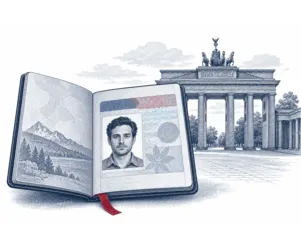
| Size | 35 × 45 mm |
|---|---|
| Head height | 34.5 mm |
| Background | light gray |
| Resolution | 600 dpi |
| Use | digital upload and print |
Germany visa photo size and basic rules
The German visa photo uses the same biometric format as the German passport photo: 35 mm wide and 45 mm high, which is 3.5 × 4.5 cm or roughly 1.38 × 1.77 inches. The size is fixed. A square photo made for another country, or a larger photo cut down with scissors, will not have the right proportions, and the officer at the counter can see that at a glance.
Inside that frame the face has a narrow window. Measured from the chin to the top of the head, the head should be 32 to 36 mm tall, so it fills about 70 to 80 percent of the photo height. Our template places it at about 34.5 mm, near the middle of the range, and leaves around 3 mm of space between the hair and the top edge. The photo file holds 600 dots per inch, so the face stays sharp when the photo is printed.
- Photo size: 35 × 45 mm, portrait orientation
- Head height: 32–36 mm from chin to crown (about 34.5 mm in our template)
- Space above the hair: about 3 mm
- Background: plain and light, preferably light grey
- Colour photo less than six months old
- Print resolution: 600 DPI, which is 827 × 1063 pixels at this size

Framing the face: pose, eyes and glasses
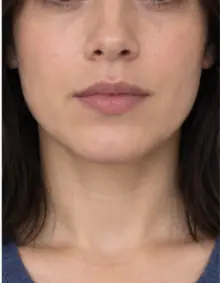
German consular staff compare each visa photo with the biometric photo sample sheet that German missions publish, and most refusals on that sheet come from the pose rather than the photo size. Look straight at the lens with your head upright, not turned or tipped to one shoulder. Keep the mouth closed and the expression neutral. Both eyes must be open and clearly visible, and hair should not fall across the eyes or the eyebrows.
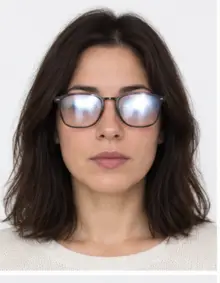
Glasses are a common source of trouble in a visa photo. Tinted lenses are not allowed, thick frames must not cross the eyes, and a reflection on the lenses can hide the pupils. If you can see well enough without them, take the glasses off for the photo; it removes the risk completely. The whole face from the chin to the hairline should be in the frame, and the head should sit in the centre of the photo with both shoulders level.
Background, light and clothing
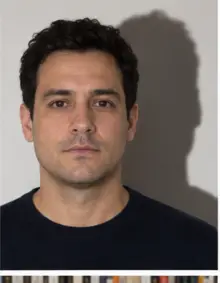
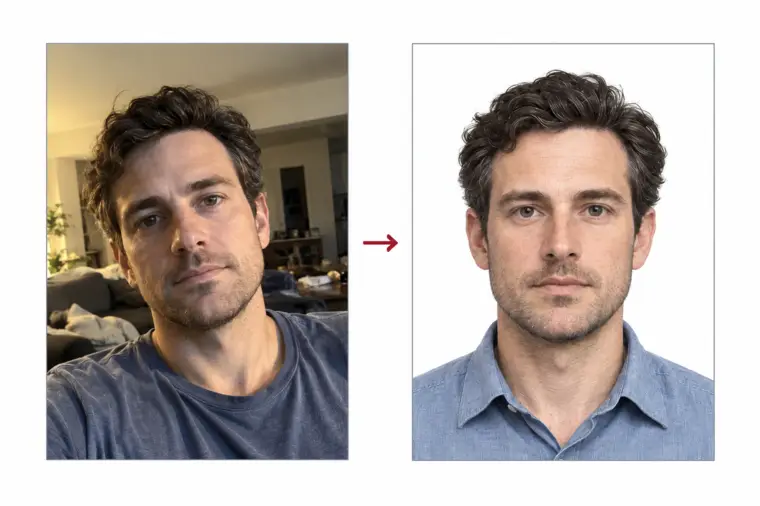
German rules ask for a plain, single-colour background that is light, and the photo instructions on the websites of German missions recommend light grey. Grey gives better contrast with pale skin and fair hair than pure white does, so our tool uses an even light grey for every Germany visa photo. You can stand in front of any wall at home: we cut you out of the photo and place you on a clean grey background with no pattern, no door frame and no shadow.
Light should come from the front and fall evenly on both sides of the face. Daylight from a window facing you works best. A ceiling lamp directly above you leaves dark eye sockets, and a lamp to one side lights one cheek and darkens the other. Avoid the flash, which causes red eyes and glare on the skin.
Wear ordinary clothes in a colour that stands apart from grey, such as navy, black or a strong colour. A grey or white top tends to blend into the background of the photo, and the outline of the shoulders becomes hard to read. Hats and caps are not allowed. A head covering worn for religious or medical reasons is accepted when the face stays fully visible from chin to forehead.
-
 Accepted
-
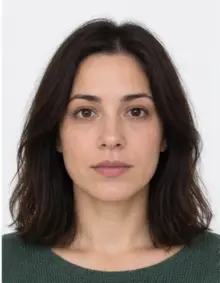 Accepted
-
 Smiling
-
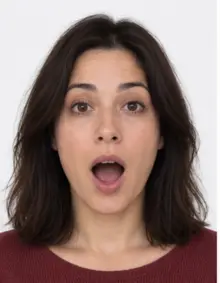 Mouth open
-
 Head tilted
-
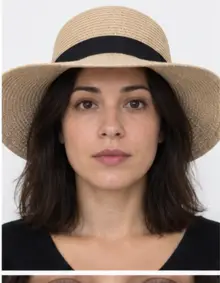 Fashion hat
-
 Shadow behind
-
 Glare on glasses
-
 Too far away
-
 Head cut off
-
 Busy background
-
 Hair over eyes
The people in these examples are AI-generated.
How to make a Germany visa photo online with our tool
You need only a phone and a few minutes. The whole process runs online in your browser, and you can download the digital photo without paying anything.
- Take a photo. Ask a friend to hold the phone at eye level about one and a half metres away, or use a timer. Leave room around the head and shoulders.
- Upload it. Germany visa is already selected in the form above. JPG, PNG and HEIC photos from a phone are fine.
- Let the tool work. We crop the picture to the 35 × 45 mm photo size, set the light grey background and run the compliance check on head size, position, eyes and light.
- Download or print. Save the digital Germany visa photo for an online application, or choose a print sheet with several copies of the photo on one page.
If the check reports something we cannot correct automatically, such as closed eyes or a turned head, take a new photo and upload it again. A second attempt costs nothing.
What the online visa photo check looks at
After the upload, our online check measures the visa photo the way a consular officer would, only faster. It finds the eyes, the chin and the top of the head, works out the head height in millimetres and compares it with the 32 to 36 mm window. It checks that the face is centred and level, that both eyes are open, that the mouth is closed, and that the visa photo is neither too dark nor washed out. It also looks for leftover shadows on the background.
Each result comes with a short note, so you know why a visa photo passed or what to change. Most problems, such as a tilted crop or a busy wall, are fixed online without any action from you. Only issues that depend on the original picture, like closed eyes or strong glare, need a retake. The check runs every time you upload, so you can try a new visa photo online as often as you need before you print.
-
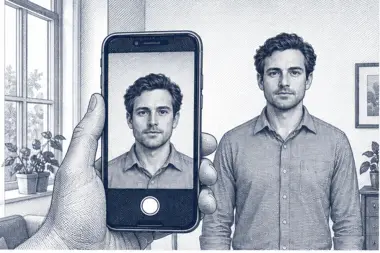 1. Take the picture
At home, against a plain wall, in daylight.
-
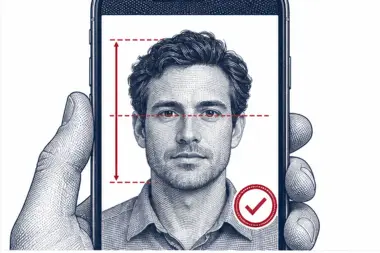 2. We check and crop
Head height, eye line and background are measured.
-
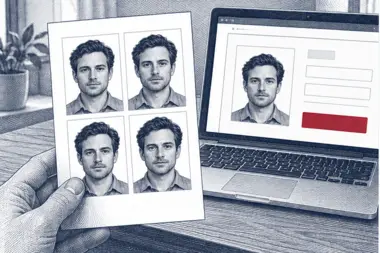 3. Download or print
A file for the upload form or a print sheet.
Where to submit your German visa photo
Short stays of up to 90 days in any 180-day period are covered by the Schengen visa (type C). You apply at the German embassy or consulate responsible for your place of residence, or at an external service provider that the mission works with, such as a VFS Global or TLScontact centre in many countries. You fill in the Schengen visa application form, attach or hand over the visa photo, and give your fingerprints at the appointment. The photo and fingerprints are stored in the EU Visa Information System.
Longer stays for work, study or family reunion need a German national visa (type D). For many of these categories the Federal Foreign Office runs the Consular Services Portal, where you file the visa application online and upload a digital photo; you still attend a short appointment in person for biometrics. Each German mission publishes its own checklist on its website (most of them sit under germany.info or auswaertiges-amt.de), and that list tells you how many printed photos to bring. The photo rules themselves are the same for both visa types, so one Germany visa photo covers either route.
Germany visa types and the photo you need
Before you prepare the photo, make sure you know which Germany visa you are applying for. The Schengen visa (type C) covers tourism, business trips, family visits and short courses of up to 90 days. The national visa (type D) is for stays longer than 90 days, such as employment, university study, vocational training or joining a family member who lives in Germany. Some nationalities also need an airport transit visa (type A) to change planes at a German airport without leaving the international zone.
All three use the same biometric visa photo: 35 × 45 mm, light background, recent and in colour. What changes from one Germany visa to another is the list of supporting documents, the fee and the processing route, not the photo size or the framing. A visa photo made here for a tourist trip therefore also fits a work or study application, as long as it is still less than six months old when you apply.
If you are not sure which visa category fits your plans, the visa section of the German embassy in your country can tell you, and many missions publish a short guide online. Settle the Germany visa type first; the visa photo is the same whatever the answer, so you can prepare it while you collect the other papers.
What else goes into a Germany visa application
The photo is one small part of the Germany visa file, but it is the part most often returned. The rest of a Schengen application usually includes the signed application form, a passport issued within the last ten years that stays valid for at least three months after you leave the Schengen area and has two blank pages, travel health insurance with cover of at least €30,000, and proof of the purpose of the trip, accommodation and funds. The visa fee for adults has been €90 since June 2024.
A national Germany visa application needs documents linked to the purpose of the stay, for example an employment contract, a university admission letter or a marriage certificate. The exact list varies by mission and by category, so always download the current checklist from the German embassy or consulate that handles your Germany visa before you book the appointment.
Digital visa photo for an online application
When a Germany visa application is filed online, the portal asks for the visa photo as an image file rather than a print. Use the file we give you exactly as it is. Do not crop it again in a gallery app, add a frame or take a screenshot of it, because each of those steps changes the photo size or lowers the quality. If the online form shows a preview that looks smaller than the full photo, that is only the preview; the full file is what the visa section receives.
Keep the original Germany visa photo on your phone or computer until the visa is issued. If the mission asks for a new upload or for printed copies at the appointment, you will not have to start again, and the printed photo will match the one you sent online.
Common reasons a visa photo is refused
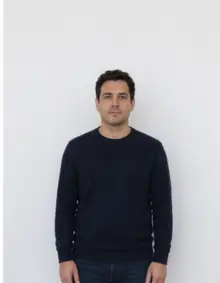
- The print is not 35 × 45 mm, or the head is smaller than 32 mm or larger than 36 mm.
- The background is patterned, dark, uneven or shows a shadow behind the head.
- The photo is in black and white, faded, or older than six months.
- The face is turned, tilted, smiling with open lips, or partly hidden by hair.
- Tinted glasses, glare on the lenses or frames across the eyes.
- The photo is blurred, too dark, overexposed or shows red eyes.
- A beauty filter or retouching changed the shape of the face.
- The photos brought to the appointment are not identical copies.
Our online check catches the size, framing, background and light issues in this list. It cannot tell when the photo was taken, so always start from a recent one.
Examples: accepted and refused visa photos
It helps to compare your own photo with a few typical cases before you upload it. Each line below describes one visa photo and the result it usually gets at a Germany visa counter.
- Accepted visa photo: head straight and centred, about 34 mm tall, light grey background, soft even light, neutral face. This is the Germany visa photo our tool produces.
- Refused, head too small: the applicant stood far from the camera and the face fills only half of the photo.
- Refused, white wall with a shadow: a lamp behind the camera threw a dark outline of the head onto the wall.
- Refused, smile: the teeth show. A visa photo needs a closed mouth.
- Refused, glasses: light reflects in the lenses and hides one eye.
- Refused, wrong format: a 2 × 2 inch photo made for another country was trimmed to fit, and the proportions are off.
- Refused, filter: skin smoothing from a camera app altered the face.
Tips for a good visa photo at home
A sharp, well-lit source photo gives the best Germany visa photo. No studio is needed; a phone camera is enough if you get the light right.
- Stand half a metre away from the wall so your own shadow falls behind you, out of the photo.
- Face a window on a bright day; overcast light is softer than direct sun.
- Hold the phone straight at eye level, not from below the chin.
- Use the rear camera if someone can help: it is sharper than the front one.
- Tie long hair back or tuck it behind the ears so the eyebrows and face edges show.
- Take five or six photos and upload the sharpest one.
- Send us the original photo file, not a copy compressed by a messaging app.
Printing the photos for your appointment
Most German missions and Germany visa centres still want printed photos, even when part of the application is online. Choose the print sheet option after the check: you get a page with several copies of your Germany visa photo, each one already at 35 × 45 mm, ready for a photo lab or a good home printer. Print on photo paper rather than plain office paper, and print at 100 percent scale, never "fit to page", or the photo size will shrink.
Cut along the guides and measure one print with a ruler: it should be 35 mm across and 45 mm tall. Keep the prints flat in an envelope, and do not write on the front. If the checklist asks you to glue a photo to the Schengen visa form, attach it only in the box marked for the photo.
Photo size in millimetres, inches and pixels
German rules give the photo size in millimetres, but phones and printers think in pixels and inches. The table below converts the Germany visa photo size so you can check a print or a file yourself.
| Measure | Width | Height |
|---|---|---|
| Millimetres | 35 mm | 45 mm |
| Centimetres | 3.5 cm | 4.5 cm |
| Inches | about 1.38 in | about 1.77 in |
| Pixels at 600 DPI | 827 px | 1063 px |
If you ever resize a visa photo yourself, keep the 35 to 45 ratio and never stretch the image in one direction. A stretched face no longer matches the head size rules, and the visa officer may ask for a new photo. Our online tool exports the file at the correct size, so there is nothing to resize.
Online visa photo, studio or photo booth
There are three common ways to get a Germany visa photo. A photo studio near a German consulate usually knows the rules, but you pay per set of prints and have to travel there. A photo booth is fast, yet the background, light and head size depend on the machine, and many booths are set up for a different photo size. Making the photo online lets you retake it as often as you like at home, see the check result straight away and print only the photo that passes.
Whichever way you choose, the visa officer applies the same rules. A studio photo with a shadow is refused just as quickly as a home photo with a shadow, so it is worth checking any visa photo against the list on this page before the appointment.
Why the German photo rules are so strict
The EU Visa Information System keeps your visa photo next to your fingerprints, and border staff in every Schengen country can compare it with your face when you arrive. A photo of the wrong size, with the head too small or with harsh shadows, gives that comparison less to work with. That is the reason German missions insist on a fixed photo size, a set head height and a plain background, and why a visa photo that looks fine to you can still be refused. Our processing changes only the crop, the photo size and the background; it never reshapes the face.
Photos of children for a Germany visa
Every traveller on a Germany visa application needs a separate photo, babies included. The size and background are the same as for adults. Small children may find a neutral face hard, and missions show some flexibility with very young applicants, but the eyes should be open and no hand, toy or parent may appear in the photo. For a baby, lay the child on a plain sheet and take the photo from above in daylight; our background step removes the folds of the fabric. Under the Schengen fee rules, children aged 6 to 11 pay a reduced visa fee of €45 and children under 6 pay none, while the adult fee is €90.
Visa photo, passport photo and old photos
Because a German passport photo and a Germany visa photo share the 35 × 45 mm size, people often ask whether a spare passport photo will do. It can, if it meets every rule above and is less than six months old. A photo from a previous visa application is usually too old, and a photo made for a different country may have a white background or another size. The safest route is a fresh visa photo for each application; making one online takes a few minutes.
Germany visa photo checklist
- The print or file has the 35 × 45 mm format.
- The head measures 32–36 mm from chin to crown and sits in the centre.
- The background is plain light grey with no shadow.
- The photo is in colour and less than six months old.
- You look straight ahead, mouth closed, eyes open and uncovered.
- You have the number of identical copies your mission asks for.
With every line ticked, the visa photo is ready for the Germany visa section or the visa centre.
Free download or premium processing
The standard Germany visa photo already covers the size, the crop, the grey background and the automatic check, and the download is free. For most applicants that is enough.
Premium processing is a paid option for people who want a second pair of eyes on the photo. We correct uneven light and colour, and a member of our team reviews the visa photo against the German rules. If the reviewer finds a problem that a new photo would fix, you upload another one at no extra cost.
| Feature | Standard photo | Premium photo |
|---|---|---|
| 35 × 45 mm Germany visa photo size | Yes | Yes |
| Light grey background | Yes | Yes |
| Automatic compliance check | Yes | Yes |
| Light and colour correction | No | Yes |
| Manual review by our team | No | Yes |
Related German document photos
A German passport, a German identity card and a German residence permit all use the same 35 × 45 mm biometric photo format, so the rules above will look familiar. Each one still has its own page in our list of documents, because the submission steps differ. If you are moving to Germany on a national visa, you will need a new photo later for the residence permit, and that photo must again be recent.
Frequently asked questions
What size is a Germany visa photo?
35 mm wide and 45 mm high, with the head 32 to 36 mm tall from chin to crown.
Which background colour should a Germany visa photo have?
A plain light background; German missions recommend light grey. Our tool sets an even light grey automatically.
Do Schengen and national visas use different photos?
No. Both visa types for Germany follow the same biometric photo rules and the same photo size.
Can I take my Germany visa photo with a phone?
Yes. Take the photo in daylight with the camera at eye level, and we handle the crop and the background online.
Is the visa photo free to download?
Yes, the digital visa photo is free. Premium processing with a manual review is an optional paid extra.
How many photos do I need for a German visa?
It depends on the mission and the visa type. Check the list of the German embassy, consulate or visa centre where you apply.
Are glasses allowed in a German visa photo?
Clear glasses with thin frames and no glare are generally tolerated, but taking them off is the safer choice.
Can I upload the photo to an online visa application?
Yes. Download the digital visa photo and upload that file unchanged where the online form asks for it.
How recent must the visa photo be?
Less than six months old on the day you apply. An older visa photo can be refused even if it meets every other rule.
Can I make the visa photo online and print it later?
Yes. Make the visa photo online now, keep the file, and print a sheet whenever your appointment is confirmed.
Do children need their own visa photo?
Yes. Every applicant, including a baby, needs a separate visa photo with the same size and background as an adult.